구독자 여러분.
뉴욕에 기반을 둔 미술, 건축 컬렉티브 Jakupsil은 뉴욕 스쿨오브비주얼아츠(SVA) 출신 작가 6인의 회화, 오브제, 설치, 혼합매체 최신작으로 구성된 전시 《TRACE: Forms That Do Not Close》를 개최합니다. 전시는 6월 12일부터 7월 18일까지 약 5주간 뉴욕 플러싱 한국일보 건물 1층 공간에서 진행됩니다. 이번 전시는 체계가 무너지고 기억이 희미해진 이후에도 남아 있는 물질적, 정서적, 공간적 흔적들을 다루는 주제하에 6인의 작가를 선정하게 되었고, 이들은 부재와 현존이 끊임없이 만나는 이 환경 속에서, 무언가의 흔적이 기록이 아닌 앞으로 올 것에 대한 열린 가능성으로 남아 있는 그 자리에 함께 머무르기를 보여줍니다. 전시는 한국일보, ARPNY뉴욕의 후원으로 기획되었습니다. 많은 관심 부탁드립니다. ^^
더 자세한 정보는 웹사이트 www.jakupsil.com 인스타 @jakupsilny & @ brettdhlee

TRACE: Forms that do not close
Jieun Cheon · Ruoxi Hua · Mina Kim · Yena Park · Evan Peltzman · Moyan Sun
June 12 – July 18, 2026
Reception: Friday, June 12, 6-8 pm
150-24 Northern Blvd., 2nd Floor, Flushing NY


Jakupsil은 뉴욕 스쿨오브비주얼아츠(SVA) 출신 작가 6인의 회화, 오브제, 설치, 혼합매체 최신작으로 구성된 전시 《TRACE II: Forms That Do Not Close》를 개최한다. 이번 전시는 우리의 삶을 조직하는 구조가 해체되거나 상실된 이후에도 완전히 사라지지 않고 열려있는 것에 주목한다. 기억과 물질, 신체와 공간은 단절과 변화를 경험한 이후에도 다양한 흔적의 형태로 지속되며, 작품들은 그러한 축적의 과정을 통해 형성되는 의미의 층위를 탐구한다. 의미는 하나의 결론으로 제시되지 않는다. 반복된 행위와 시간의 축적, 그리고 현재의 인식을 끊임없이 변화시키는 기억의 작용 속에서 서서히 구축되며, 참여 작가들에게 형태는 미리 주어진 결과가 아니라 물질, 노동, 기억, 지각이 지속적으로 만나며 생성되는 과정에 가깝다.
전시는 인식과 현실 사이의 간극, 질서와 혼돈, 친밀함과 거리감, 존재와 부재가 교차하는 경계의 영역을 가로지른다. 믿음 체계로부터 구축된 가상의 세계는 완전한 이해를 거부하고, 도시의 비장소들은 익명성과 소외를 냉랭하게 드러낸다. 수년간의 노동을 통해 축적된 구조물은 신체의 지속성과 이주의 흔적을 담아내며, 소음과 차단, 기억으로 층위화된 표면은 과거와 현재의 공존을 품는다. 감정적 잔여는 연결이 사라진 후에도 오래 지속되고, 손이 물러난 후에도 물질의 장은 팽창과 소멸의 순환 속에서 계속 움직인다. 리쾨르가 이해한 흔적의 개념처럼 기억은 단순한 과거의 기록이 아니라 현재를 능동적으로 구성하는 살아있는 힘이며, 메를로-퐁티가 강조했듯 신체는 제작의 도구가 아니라 지속적인 신체적 만남을 통해 형태가 스스로를 발견해나가는 장소이다. 이러한 작업들은 완결된 상태보다 생성과 변화의 과정에 더 가까이 위치한다.
천지은은 신화와 종교적 도상, 과학적 참조를 결합한 가상의 세계를 구축하며 인식의 한계와 이해의 불가능성을 탐구한다. 그의 연작 Uncanished Workld — An Epistemological Inquiry는 질서와 혼돈, 믿음과 지식, 생성과 소멸 사이의 긴장을 다루며, 언어로 서술될 수 있으나 완전히 포착될 수 없는 영속적 미완의 세계를 제시한다. 천지은이 언어가 닿지 못하는 경계에서 세계를 구축한다면, 김미나는 언어가 실패하는 자리에서 작업을 시작한다. 아버지의 차고에서 수집한 철사와 어머니의 주방 서랍 속 플라스틱 타이 등 사적인 일상의 재료로, 보호와 감금 사이의 경계를 오가는 섬세한 구조물을 손으로 구축한다. 반복은 조형의 방식이자 수행적 사유의 형태로 기능하며, 지속적인 노동을 통해 작업은 사고가 물러나고 행위 자체에 집중이 전면화되는 제의적 과정이 된다. 이주와 문화적 이동의 경험을 바탕으로 한 그의 작업은 두 문화적 논리 사이에서 동시에 보이지 않으면서도 노출된 채, 돌봄과 생존의 행위로서 축적만으로 존재를 부정할 수 없게 만든다. 다공성의 구조물들은 조각, 드로잉, 환경 사이의 경계를 흐리는 그림자를 드리우며, 관람자가 천천히 그 안을 통과하고 머물도록 유도한다.
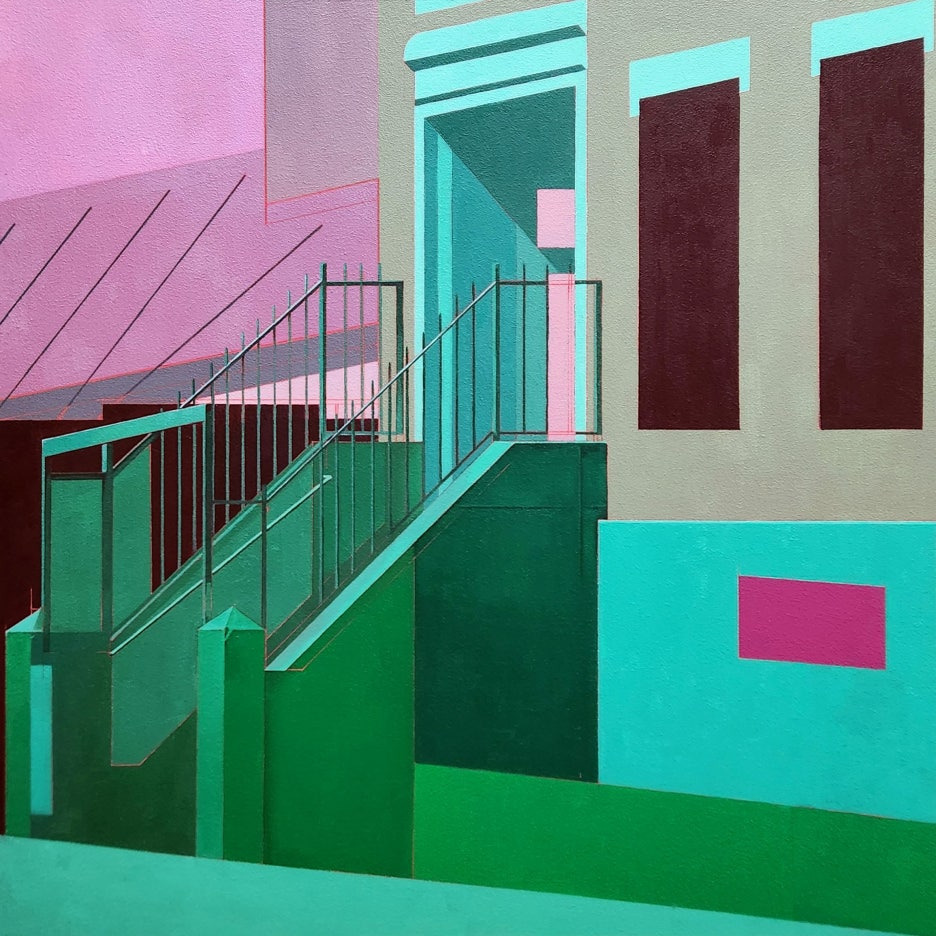
화뤄시는 나무 패널을 연결한 회화를 통해 도시 환경 속 외면된 장소들에 주목한다. 골목, 이면도로, 공중화장실, 지하철역, 주차장, 식료품점 등 사회적 기능을 최대화하고 심미성을 최소화하도록 설계된 비장소(non-place)들의 전이성과 심리적 불연속성을 탐구한다. 화면을 가르는 물리적 구성과 색채 분할을 통한 분절은 공간적 불연속성에 대한 시각적 은유를 구축하며, 극단적인 크롭으로 정보를 의도적으로 배제하고 심리적 접근을 차단함으로써 작가가 경험하는 미로와 같은 공간 감각을 시각화한다. 화뤄시가 도시 공간의 파편화를 통해 심리적 차단을 드러낸다면, 에반 펠츠만은 회화의 표면 자체를 파편화하여 시간이 축적하는 것을 담아낸다. 다층적인 패널 구조와 목공 작업, 반복적인 마킹을 결합한 그의 작업에서 각 층위는 과거와 현재의 공존을 상징하며, 가장 앞의 층은 현재로, 배경의 층들은 기억과 회상으로 기능한다. 소음, 정지, 반복은 구성을 방해하는 요소가 아니라 전체와 조화를 이루며, 유년기의 기억, 사회적 불평등, 주거 문제, 도시적 삶에 대한 참조들이 과거와 현재가 동일한 평면을 점유하는 표면 위에 축적된다.
박예나는 정서적 잔향, 친밀성, 그리고 인식의 불안정성을 회화를 통해 탐구한다. 초현실적 이미지와 분절된 실내 공간, 상징적 모티프를 결합한 그의 작업은 애착과 상실 이후에 남겨지는 심리적 흔적을 다룬다. 가공되지 않은 천, 반투명한 층위, 변화하는 색채의 분위기는 기억과 투사가 교차하는 공간을 형성하며, 인물과 사물, 환경은 불확실한 정서적 풍경 속으로 스며든다. 미완의 형태와 노출된 표면은 부재를 성찰과 가능성의 장소로 전환한다. 쑨모옌의 작업 역시 완결보다 과정 안에 머문다. 반복, 축적, 그리고 미세한 교란을 통해 변화하는 물질적 화면을 구축하며, 안료, 실, 천, 종이, 발견된 오브제를 결합한 구성은 응집과 해체 사이를 오가며 끊임없이 변화하는 상태를 유지한다. 많은 작업이 배양 접시처럼 기능하며, 색이 확장되고 형태가 생성되는 가운데 제스처가 천천히 쌓인다. 유기적 구조와 신체 감각, 신경학적 시스템을 사유의 평행 체계로 삼아 형태가 생성되고 사라지며 다시 연결되는 다공성의 시각적 장을 구성하고, 함께 설치될 때 팽창과 소멸, 회귀가 동시에 일어나는 하나의 연속적인 장을 형성한다.
이번 전시는 체계가 무너지고, 기억이 희미해지고, 정체성이 흔들린 이후에도 남아 있는 물질적, 정서적, 공간적 흔적들이 모여 이루는 자리다. 여섯 작가의 작업은 축적과 변형의 과정을 전면에 내세우며, 부재와 현존이 끊임없이 만나는 환경을 제시한다. 이 작업들과 마주한다는 것은 그 사이 어딘가에 머무는 것이다. 무언가의 흔적이 기록이 아닌, 앞으로 올 것에 대한 열린 가능성으로 남아 있는 그 자리에 함께 있는 것이다.
Text | Brett Lee


Jakupsil presents TRACE: Forms That Do Not Close, an exhibition of recent work by six New York-based artists across painting, object, installation, and mixed media. The exhibition turns its attention to what persists after the structures that once organized our lives have given way — not vanished, but continuing in altered form. Memory, material, body, and space endure through rupture and change, and the works explore the layers of meaning that accumulate in the aftermath. Meaning here is not delivered as conclusion. It builds slowly — through repeated action, through the weight of lived time pressing into surface and material, through memory operating not as fixed record but as something that continues to act on perception long after its origin has passed.
The exhibition moves through threshold spaces where comprehension meets its limits, order gives way to chaos, intimacy shades into estrangement, presence into absence. A speculative world built from systems of belief strains against the gap between perception and reality; urban spaces register anonymity and estrangement with cold precision; structures built from years of labor carry the traces of displacement and the persistence of care and survival; surfaces layered with noise, obstruction, and memory hold the coexistence of past and present; figures dissolve into shifting psychological spaces where emotional residue persists long after connection has faded; and material fields keep shifting through cycles of expansion and dissolution long after the hand has withdrawn. Memory materializes not as image but as force — what Ricœur understood as the trace: the living residue of what was, still actively shaping the present. The body, as Merleau-Ponty insisted, is never merely the instrument of making; it is the site where form discovers itself through sustained physical encounter. These works exist closer to the process of becoming than to any finished state.
Jieun Cheon constructs a speculative world by combining mythological imagery, religious iconography, and scientific reference — exploring the limits of rational understanding and comprehension. Her ongoing series Uncanished Workld — An Epistemological Inquiry navigates the tension between order and chaos, belief and knowledge, construction and decay, presenting a world that can be described through language but never fully contained, remaining in a state of perpetual incompletion. Where Cheon builds worlds at the edge of what language can hold, Mina Kim begins where language fails altogether. Using wire salvaged from her father's garage and plastic twist-ties from her mother's kitchen drawer — modest materials from intimate domestic spaces — she constructs hand-formed structures that hover between shelter and cage. Repetition functions not only as construction but as contemplative practice: through sustained labor, the work becomes a ritual process in which thought recedes and attention shifts fully to the act itself. Grounded in experiences of migration and cultural displacement — suspended between two cultural logics, simultaneously invisible and exposed — her practice becomes an act of care and survival. Her porous structures cast shadows that blur distinctions between sculpture, drawing, and environment, drawing viewers to move slowly through, pause within, and linger.
Ruoxi Hua turns his attention to overlooked spaces in urban environments through paintings on connected wood panels. Drawn to non-places — alleyways, side streets, public bathrooms, subway stations, parking lots, and grocery stores: spaces designed to maximize social function and minimize aesthetics — he focuses on the transitional quality of spaces where individuals remain anonymous and identity becomes indistinct. The physical divisions and chromatic fragmentation that cut across his picture plane construct a visual metaphor for spatial discontinuity, while extreme cropping deliberately withholds information and blocks full psychological access, capturing the maze-like quality of the non-spaces he depicts. Where Hua exposes psychological disconnection through the fragmentation of urban space, Evan Peltzman fragments the picture surface itself to hold what time accumulates. Combining layered panel construction, woodworking, and rhythmic mark-making, his works integrate repetition, fragmentation, and visual interference into densely structured compositions — each layer symbolizing the coexistence of past and present, the foremost surface as now, background layers as memories and flashbacks — noise and static harmonizing within the whole rather than disrupting it. Recurring references to childhood memory, social inequality, housing, and urban life accumulate across surfaces where past and present occupy the same plane at once.
Yena Park's paintings investigate emotional residue, intimacy, and the instability of perception. Combining surrealist imagery, fragmented interiors, and symbolic motifs, her work examines the psychological traces left behind after attachment and separation. Untreated fabric, translucent layers, and shifting chromatic atmospheres create spaces suspended between memory and projection, where figures, objects, and environments dissolve into uncertain emotional terrain. Incomplete forms and exposed surfaces transform absence into a site of reflection and possibility. Moyan Sun's practice develops through repetition, accumulation, and subtle disruption — combining pigment, thread, fabric, paper, and found materials in compositions that remain in states of continual transition, balancing containment and dissolution. Many works function like petri dishes: contained environments where colors expand, forms take shape, and gestures slowly accumulate. Drawing from organic structures, bodily sensation, and neurological systems as parallel frameworks, Sun constructs porous visual fields where forms emerge, recede, and reconnect; installed together, the works form a continuous field in which expansion, dissolution, and return occur not in sequence but concurrent.
The exhibition gathers the works on view as a constellation of residual marks — material, emotional, and spatial traces that remain after systems fracture, memories fade, or identities shift. Together, the works foreground processes of accumulation and transformation, offering environments where absence and presence continually converge. To engage these works is to remain in that interval — where the trace of something persists not as documentation but as an open claim on what comes after.


| CONTACT Brett Lee, Founder and Director T. +1 215 906 5200 E. brett@jakupsil.com W. www.jakupsil.com IG. @brettdhlee |
Gallery Hours: Wed ~ Sun 11AM - 6PM Thurs by Appointment 150-24 Northern Blvd. 2nd Floor Flushing, NY |